When Determination Meets Nature’s Natural Armor
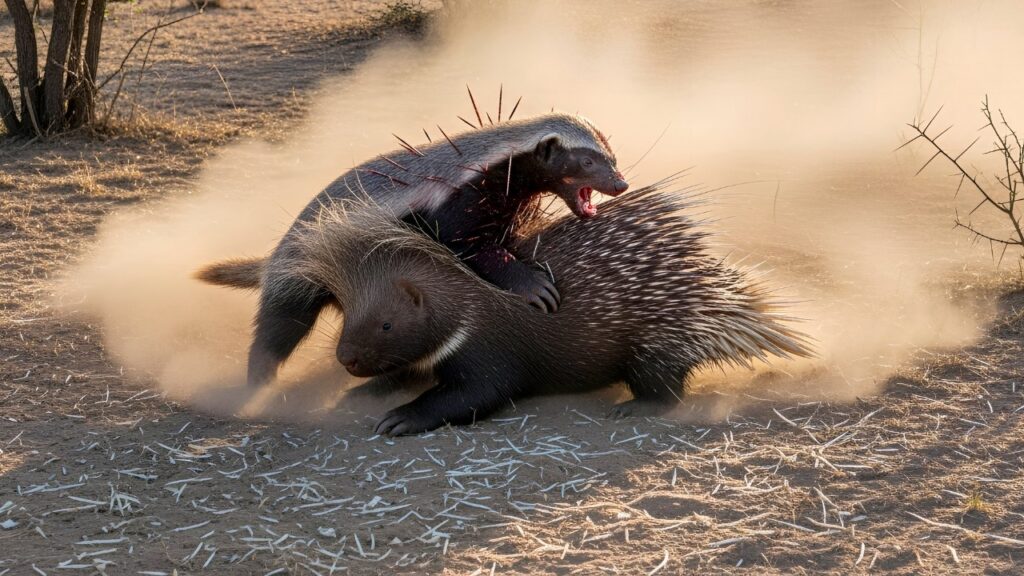
In the wild, even the most persistent hunter can encounter a challenge that demands more than strength. The honey badger is known for its powerful build, strong claws, and remarkable ability to investigate difficult situations. Yet, when it encounters a porcupine, even this resilient mammal must contend with one of nature’s most effective defensive adaptations.
A porcupine’s quills serve as a protective barrier against potential predators. When threatened, it can turn its body and present its sharp spines, making a direct approach risky. The quills are not launched at an attacker, but they can detach and become embedded when an animal makes contact.
This wildlife encounter offers a fascinating look at the difficult balance between persistence and self-preservation. As the two animals face one another, every movement can influence what happens next. In nature, survival often depends not only on strength and determination, but also on timing, caution, and the ability to respond to danger.
A Powerful Lesson in Wildlife Survival
The encounter between a honey badger and a porcupine illustrates how differently animals protect themselves and pursue their needs in the wild. The honey badger’s sturdy body, powerful forelimbs, and thick, relatively loose skin help it handle challenging encounters. However, these adaptations do not make it immune to injury.
For the porcupine, its quills provide a valuable defense. Contact can leave painful spines embedded in an attacker’s skin, and deeply embedded quills may cause serious complications if they are not removed. Despite this protection, porcupines must still navigate their surroundings carefully, particularly when facing persistent predators.
What makes encounters like this so compelling is the uncertainty of the outcome. A predator may continue trying to approach its target, change tactics, or eventually withdraw when the risks outweigh the potential reward. Without a clear view of the encounter’s conclusion, it would be misleading to assume that either animal ultimately prevailed.
Beyond the dramatic appearance of the quills, this moment offers an important reminder: wildlife survival is rarely simple. Every species has developed its own ways of finding food, avoiding danger, and responding to challenges. Understanding these behaviors helps us appreciate wild animals without forgetting that both predator and prey face real risks.
Nature does not always offer an easy victory. Sometimes, survival depends on knowing when to persist, when to adapt, and when to move away.